
For every ambitious company there’s a moment when the dream collides with reality. Spreadsheets fail, customer data gets scattered, and operations feel held together by duct tape. At that moment, leaders know they need a 'system.' But many stumble by confusing ERP with CRM, a mistake that can derail growth.
Imagine a scaling Luxury Furniture maker. The sales team is on fire, high-fiving over new orders. But in the back, the production manager is in a panic. He's out of premium leather for a top-tier client's custom sofa, and the order is already delayed. The CEO, desperate to 'fix the growth problem,' invests in a state-of-the-art CRM because 'everyone says it's the engine of growth.'
Six months later, the sales team has a dazzling pipeline dashboard. They know every lead. But the factory floor is still chaos. They can't tell the customer when their sofa will be ready. Why? Because the CRM was built to get the order, not to manage the leather inventory. They tried to fix a back-office nightmare with a front-office dream.
Now flip the story. A beloved boutique retail chain with five locations wants to level up. To manage their inventory and payroll, they choose a robust ERP system. They become a well-oiled machine. They always know exactly how many ceramic mugs are in stock across the region. But sales are flat. Why? Because their marketing team still doesn't know who bought the minimalist design versus the ornate pattern. They can't create a personalized email for the client who collects the limited-edition series. Their ERP knows the mug, but it doesn't know the customer.
This is the hidden danger of business growth. Are you optimizing how you deliver, or are you scaling how you engage? Both systems are powerful, but they solve entirely different crises. Choosing the wrong one isn't just a wasted investment it’s like buying a bulldozer to plant a rose garden. You might have the best intentions, but you're guaranteed to crush what you were trying to nurture.
What is ERP?
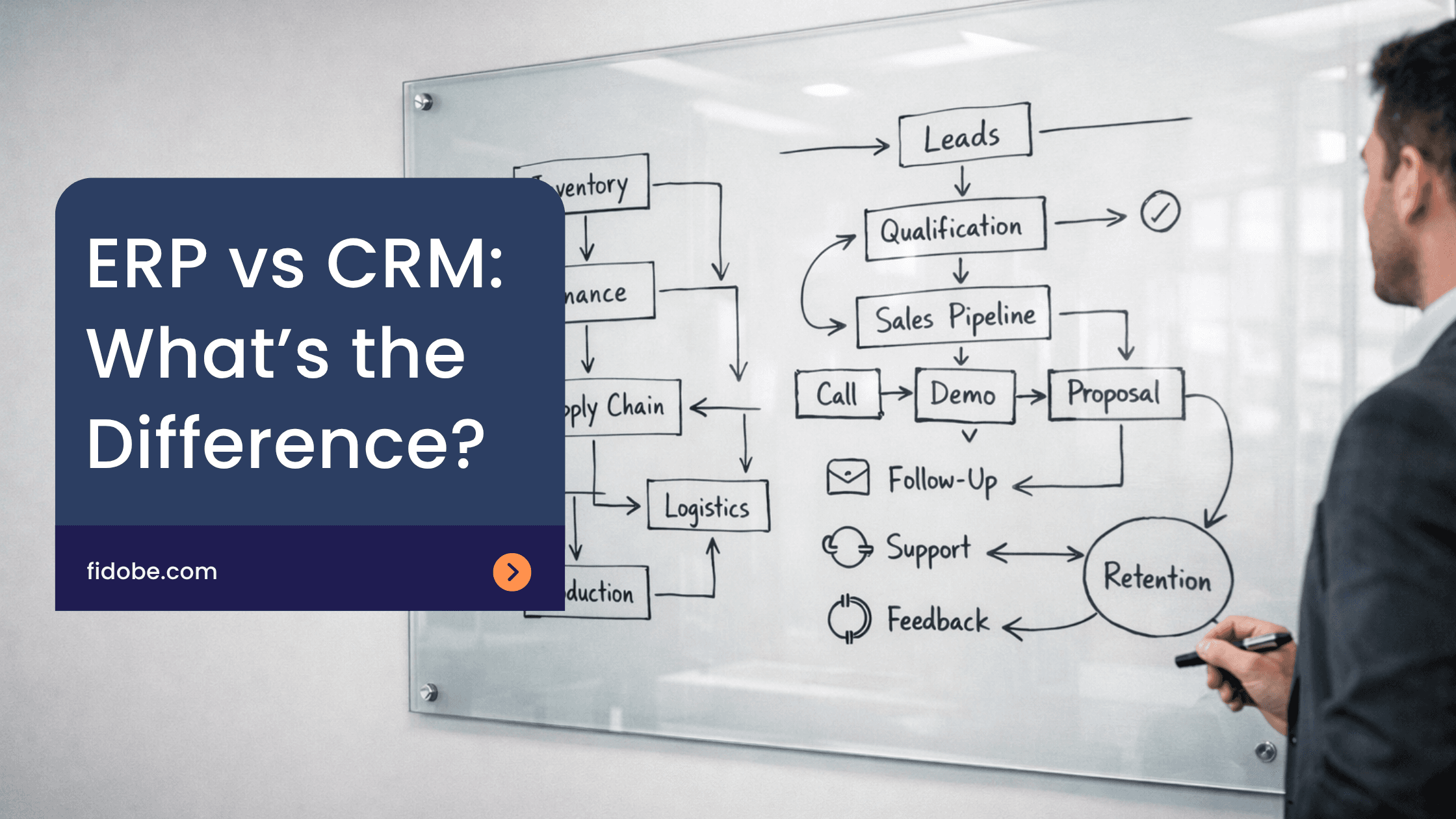
ERP (Enterprise Resource Planning) is the backbone of internal operations. It integrates core business processes finance, supply chain, HR, manufacturing into one unified system.
Key Features of ERP
• Finance Management: Automates accounting, payroll, and compliance reporting.
• Supply Chain Visibility: Tracks inventory, procurement, and logistics in real time.
• Human Resources: Manages employee records, payroll, and performance.
• Manufacturing & Production: Streamlines scheduling, resource allocation, and quality control.
Why Businesses Use ERP
ERP is about efficiency. It reduces duplication, eliminates manual processes, and ensures every department works from the same data. For companies scaling fast, ERP becomes the operational backbone.
What is CRM?
CRM (Customer Relationship Management) focuses on external relationships customers, leads, and prospects.
Key Features of CRM
• Sales Pipeline Management: Tracks leads, opportunities, and conversions.
• Customer Service: Centralizes support tickets, inquiries, and feedback.
• Marketing Automation: Manages campaigns, email outreach, and customer segmentation.
• Customer Insights: Provides a 360° view of customer history and preferences.
Why Businesses Use CRM
CRM is about growth. It helps sales teams close deals faster, marketing teams personalize outreach, and customer service teams build loyalty. For businesses competing in crowded markets, CRM is the growth engine.
ERP vs CRM: The Core Differences
1. Focus and Purpose
ERP is built to streamline internal operations. It integrates finance, HR, supply chain, and production into one system, ensuring efficiency and scalability. The goal is to reduce duplication, cut costs, and provide a single source of truth for decision-making.
CRM, on the other hand, is designed to strengthen external relationships. It helps businesses manage leads, track customer interactions, and personalize engagement. The goal is growth boosting sales, improving customer satisfaction, and driving revenue.
2. Users and Data
ERP is primarily used by operations, finance, HR, and supply chain teams. The data it manages includes payroll, compliance, inventory, procurement, and production schedules. It’s the system that keeps the business running smoothly behind the scenes.
CRM is used by sales, marketing, and customer service teams. It manages customer histories, preferences, leads, and opportunities. CRM data helps teams understand customers better, forecast sales, and deliver personalized experiences.
3. Implementation and Integration
ERP implementations are often longer and more complex, requiring significant resources and planning. They typically integrate with accounting, manufacturing, and compliance systems to ensure operational alignment.
CRM implementations are usually faster and lighter, with integrations focused on marketing automation, email, and customer support tools. This makes CRM easier to adopt, especially for businesses looking to quickly improve customer-facing processes.
4. Scalability and Impact
ERP scales with business operations and workforce expansion. As companies grow, ERP ensures that processes remain efficient and compliant. It impacts decision-making by providing insights into resource allocation, financial planning, and operational efficiency.
CRM scales with customer base growth and sales pipeline expansion. As customer demands increase, CRM helps businesses maintain strong relationships and improve sales forecasting. Its impact lies in better customer engagement, marketing strategies, and revenue growth.
How ERP and CRM Work Together
While ERP and CRM serve different purposes, they’re most powerful when integrated.
• Example: CRM tracks customer demand → ERP ensures inventory and supply chain readiness.
• Benefit: Sales teams promise delivery dates confidently because ERP confirms stock availability.
• Result: Customers are happier, operations are smoother, and forecasting becomes more accurate.
Integration creates a 360° view of the business—internal efficiency plus external growth.
Which One Does Your Business Need?
Choose ERP if…
• You struggle with operational inefficiencies.
• Scaling requires better resource management.
• Compliance and reporting are major challenges.
Choose CRM if…
• Customer acquisition and retention are top priorities.
• Sales teams need better visibility into pipelines.
• You want to personalize customer experiences.
Choose Both if…
• You want end‑to‑end visibility from operations to customer engagement.
• Your business is scaling rapidly and can’t afford silos.
• You want to align growth with efficiency.
The Strategic Lens
Think of ERP and CRM as two sides of the same coin:
• ERP keeps the business running smoothly.
• CRM ensures the business keeps growing.
Choosing the right system or the right combination isn’t about following trends. It’s about aligning technology with your business strategy.
ERP and CRM are not rivals they’re complementary tools. ERP is the operational backbone, CRM is the customer growth engine. The danger lies in confusing them, investing in the wrong system, and watching your business struggle with the same problems you set out to solve.
The smartest businesses don’t ask “ERP or CRM?” They ask: “What do we need right now, and how can these systems work together to drive long‑term success?”
Don't let your growth hit that wall. If your back office is chaos and your operations are running on duct tape, it's time for an ERP solution. We specialize in helping companies implement the right ERP system to streamline their operations, manage their resources, and fuel their sustainable growth. Visit our website today to learn more and schedule your consultation. Let's build a foundation for your future.